Author and Scriptwriter

'Among the most important writers of contemporary British horror.' -Ramsey Campbell
Showing posts with label What's New. Show all posts

Wednesday, 12 November 2025

Interview: Stewart Hotston talks Project Hanuman!

Stewart Hotston, in his own words: "I’m a short and long fiction writer repped by John Baker at Bell Lomax Moreton. I am also one of the co-owners of Flow State Games which runs (among other games) Curious Pastimes, one of the UK’s biggest fest larps with c.1500 players at our main events. I spend a lot of time writing for that and it’s one of my joys in life – I believe that anyone who’s played video games or D&D would love LARP.

My stories are about odd situations that are bigger than the people in them. They’re typically Sci Fi, Fantasy and often quite weird. They’re about changing the world and realising that we can all have a part in that. My non-fiction tends to be about these very same subjects." 

Stewart's very kindly agreed to talk to me about his new novel, Project Hanuman, which was released yesterday by Angry Robot. Read on...

1) So, what’s new from you?

Project Hanuman! It’s a new space opera but also a retelling of how Hanuman lost his powers. It’s set within a utopian civilisation called the Arcology who span much of the galaxy but live mostly online. It’s not too much of a spoiler (welcome to chapter 1) to say they get destroyed at the beginning and the rest of the story is about a group of survivors trying to wrestle with what’s happened.

 2) How did it come about?

I’ve been wanting to write a space opera for a long time but I’ve never quite figured out the story. Part of the reason for that is I wanted to bring the experience of a far off galactic civilisation up to date – using the most cutting edge physics. Thing is, there’s a lot of physics out there that most people haven’t ever heard of and much of it is so counter-intuitive that writing about it could feel entirely alienating in a bad way.

After my BFS and Subjective Chaos nominated novella, The Entropy of Loss from NewCon Press, seemed to find a great audience I started to think I had a way forward – which was to concentrate on just how strange the idea of information is within mathematics and modern physics.

3) Tell us about the process of how you created it.

The thing about hard science is that it’s hard. Popular science books have to flatten and simplify it – if for no other reason than the language of these things is mathematics and if you can’t speak that much of what modern physics has to say about the universe is beyond reasonable reach.

You obviously can’t write that on the page and expect anyone to be interested or for it to make for a thrilling story. I can imagine people thinking, oh, this is ‘hard science’ and switching off immediately as it not being for them. That’s the furthest thing from what I want to achieve.

Fortunately for me I’ve been long enthralled by the story of Hanuman, spiritual child of Vayu the wind god. There are many stories about how Hanuman lost his powers but they all centre on someone needing to learn how to control their power – not in the sense of flying better but in the sense of power without control is dangerous to everyone around us.

This was my way in – a fantastic story about a powerful being reduced to nothing and having to learn about responsibility from the ground up.

4) What was your favourite part of the process?

Figuring out the main characters. Prab and Kercher (together with Hanuman). Prab was my everybody, the ordinary person thrust into astonishing events. Kercher’s my reject, the one who is torn about the system they’re supposed to save.  

As always, a great story has to be driven by the characters not the setting.

5) What was the toughest part of it?

Navigating that line between the madness of how modern science describes the universe and creating a story in which everything feels interesting and familiar enough to have you turning the page.

6) Is there a theme running through it?

When big events dwarf us how do we find meaning, how do we make a difference when it feels like we have no power. To be honest, that feels pretty important to me right now.

7) What are you working on now?

I have a bunch of stuff coming! Next year I have a Cold War SF novel and following swiftly on its heels the first of an Epic Fantasy duology set for 2027. Alongside those will also be a light-hearted portal fantasy series also due to launch in 2027.


I'm exhausted just reading that list! Thanks so much for talking to me, Stewart, and here's hoping Project Hanuman is the first of many huge successes!   

Wednesday, 3 February 2021

What's New? with Dave Jeffery

Dave Jeffery is the author of 15 novels, two collections, and numerous short stories. His Necropolis Rising series and yeti adventure Frostbite have both featured on the Amazon #1 bestseller list. His YA work features critically acclaimed Beatrice Beecham supernatural mystery series. His screenwriting credits include award winning short films Ascension and Derelict.

Jeffery is a member of the Society of Authors, British Fantasy Society (also as a regular book reviewer), and actively involved in the Horror Writers Association where he is a mentor on the HWA Mentorship Scheme. Jeffery is married with two children and lives in Worcestershire, UK.

1) So, what’s new from you?

Hi, Simon. First of all, I’d like to say thank you for being a generous host.

In terms of new projects, I have just released the second book in my A QUIET APOCALYPSE series through DEMAIN PUBLISHING. The series is set after a pandemic, where a mutant strain of meningitis (MNG-U) has left most survivors deafened and dependent on those few who have retained their hearing. The novella is called CATHEDRAL and features a cordoned off section of Birmingham city centre, where a fledgling society keeps order using spurious methods of social control.

Like the first book, the story is told from a single person point of view. Where the original novella featured a hearing survivor enslaved by a deafened farmer, CATHEDRAL focuses on a deafened woman living in a town that is terrified of returning to the chaos prevalent in the immediate aftermath of the collapse of civilisation. The town’s presiding council use a bastardised version of Maslow’s Hierarchy of Needs (known now as Maslow’s Law) where community comes before all, and there is no scope for individuality. Failure to adhere to Maslow’s Law means The Corral, a place where dissent is met with ritualised punishment.

2) How did it come about?

A QUIET APOCALYPSE was meant to be a standalone volume. Critical and reader response was highly positive, but there was consistent interest in what was going on outside the experiences of our hearing protagonist. A few reviewers were captivated by the mention of CATHEDRAL, an almost mystical place that meant different things to different people. This had me thinking about CATHEDRAL as a construct of social control in a world never too far away from falling to ruin.

3) Tell us about the process of how you created it.

As a concept, CATHEDRAL was in my head as context for pending interviews. I decided that it would be of value to write these ideas down. This process made more sense once words were on the page. The story seemed such a natural progression, it made perfect sense to develop it into another novella. Looking at the isolating nature of deafness, I wanted to maintain the single person perspective and use it as a device to compound that sense of alienation for the reader. This works extremely well for the story, but I readily accept this kind of narrative does not appeal to all.

4) What was your favourite part of the process?

The story came so effortlessly, felt so right from the outset, that the whole process was as exciting as it was unusual. The basic story structure was there from the start, with a few tweaks in the second draft, to knit together any loose strands. Maslow’s Hierarchy of Needs was something that came to mind when I was considering the society in which our protagonist lives. I had worked with Maslow’s model during my time as a mental health professional (35 years in the NHS) and its core concepts worked so well until applied to a society as a whole. This is deliberate, of course, as the model is for the development of individuals to become the best they can be. If you remove individuality from the equation, in this instance by culling the top two tiers of Maslow’s triangle relating to personal growth and self-actualisation, you have an effective social model with no scope for individualism. Add to this fears of an existential threat, then I felt the scene was set for strong drama. Weaving this into the storyline was my favourite part of the project and reinforced that I was doing something different.

5) What was the toughest part of it?

There are some scenes in the book that are very brutal, but I wanted to make sure that they were not sensationalised or marred by inept delivery. This is an extremely horrific story but not a book of extreme horror, so maintaining a balance was important when putting those scenes together. In the end, I made the controversial aspects of these events almost an afterthought of the protagonist as they rationalised their involvement in what is ritualised retribution on Harbingers, that is those culturally Deaf people who are blamed (without evidence) for the end of humanity. This was then contrasted by the response to this practice by someone who has just arrived in Cathedral and witnessing the atrocities for the first time.

These scenes were difficult to write and difficult to get right, but they are so important to demonstrate how, by trying to keep away from chaos, we step ever closer to losing something far more terrifying. I think they work well, and reviews so far have not been contrary to this early conclusion.

6) Is there a theme running through it?

The central theme is that of abject fear of isolation - that created by the disease and also of being alone in a world that has fundamentally changed – and how, as human beings, we maintain our sense of well-being. The idea that self-imposed adversity, shared through community, is better than the crippling terror of fending for oneself in a hostile environment is at the heart of the book. It asks the question: “Are some horrors easier to accept if they mean preventing something far worse?” Ultimately, I’ll leave that to the reader to decide.

7) If you had to sum this story up in three words, what would they be?

Unique dystopian horror.

8)
Where can/will we be able to get hold of it?

CATHEDRAL is out now in eBook format on Amazon by following this LINK.

The paperback is coming at the end of February/early March 2021.

Thanks again for allowing me to share these insights with your readers!

Friday, 15 January 2021

What's New? with... Jonathan Oliver

Jon's the one in the middle.
Jonathan Oliver is an award winning editor and writer. Once a former 2000 AD droid, he is best known as the former commissioning editor for Solaris and Abaddon Books. He lives in Oxford with his family and fixes words for money.

1) So, what’s new from you?

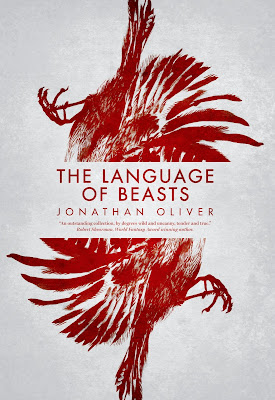
Well, apart from continuing to heal from two years of a deeply damaging office job, after deciding to leave genre publishing for a bit (great decision, Jon!), I’ve just about managed to pull myself together in 2020 – with slight sanity wobbles due to, you know, a global pandemic – and that lovely chap at Black Shuck Books, Steve Shaw, agreed to publish my debut collection, The Language of Beasts.

2) How did it come about?

The collection comprises around 10 years of short stories, most of them previously published. I’ve been writing for a lot longer than that, but these tales feel to me like the strongest I’ve written to date. Originally the collection was picked up by ChiZine, but then… you know, things happened, and I had to get my rights back. Thankfully that wasn’t too big an issue. I remember Steve saying to me at Fantasycon in Glasgow that he would have been pleased to have published the collection, so I offered it to him, and we were back in business. Steve is wonderful to work with and hugely accommodating, especially as I chose the cover design. I used to hate it as a commissioning editor when authors would say, “I have this mate who’s great at covers…” Fortunately my mate is Simon Parr who used to be Head of Design at Rebellion, so I knew he would knock it out of the park.

3) Tell us about the process of how you created it.

It got to the point where I realised I had enough for a collection, and that some of it was good enough for a collection. So, I looked at the stories on my PC and winnowed it down to the best ones. Then I put them together, got the brilliant Sarah Lotz to write an intro, managed to gather brilliant blurbs from authors I loved, and then sent it out and waited... and waited… It took about 3 years for it to finally find a publisher. Then that publisher had its… issues, and then Black Shuck came along, and I couldn’t be more delighted to be in such fine company.

4) What was your favourite part of the process?

I’ve never found writing easy. I always have to drag myself away from life’s distractions, and then it’s a fairly drawn-out process. I’m terribly undisciplined. My favourite part is having written and having something I’m pleased with. Also, seeing the finished book in your hand is a big thrill. Getting Simon to design the cover and the ease of working with Steve made the publishing aspect all rather easy and agreeable.


5) What was the toughest part of it?

The self-doubt, the anxiety – all the usual author quibbles. The deal with ChiZine turning sour was a bit of a bugger to say the least, especially as so many good friends were wrapped up in the messy fallout. Choosing a running order is a bit of an art too, I think, and took a while. Really, though, I have very little to complain about.

6) Is there a theme running through it?

Those who know me well will be fairly unsurprised that religion, issues of faith, and vicars crop up more than once. It’s hard to pick apart what the major themes are, though, as I don’t analyse myself to that extent. That’s the readers’ job.

7) If you had to sum this story up in three words, what would they be?

Strange dark stories.

8) Where can/will we be able to get hold of it?

You can get the lovely hardback from Black Shuck Books, and in all the usual online book retail venues (which don’t have to include Amazon).

Wednesday, 5 June 2019

What's New? with Yvy DeLuca


Yvy DeLuca describes herself as a delicious Yvycake made of up an assortment of ingredients designed to stimulate the mind, as well as satisfy a hunger for self-expression. As a proud Indian transgender woman, Yvy uses written and video blogs to talk about trans issues by using #LetsTalkAboutTrans and uses her social media to spread awareness and support for the LGBTQ community. Yvy grew up in Blackburn and currently resides in Salford, Greater Manchester, with her husband and their cats, Nyssa and Pirlo.


1. So, what’s new from you?
My debut book, Tainted Beauty, which is currently in it's final stages of proofreading before I get a release date!


2. How did it come about?
I decided that I wanted to tell my story as an Indian transgender woman and what I experienced going through my transition. I felt like I needed to tell my story because there are a lot of questions that society are afraid to ask, and in my book the reader will come away with more answers than questions...and one hell of a fabulous read!


3. Tell us about the process of how you created it.
I started writing my book during a time when I became very ill and was housebound. It gave me buckets of time to really process my life into a story and build a wonderful narrative that was heartfelt and unapologetic but also showcased my fun loving personality.


4. What was your favourite part of the process?
Watching my husband's reaction when he got the opportunity to really learn about what I have been through.


5. What was the toughest part of it?
Having to not only relive some of the darkest moments in my life, but then having to write them down in detail. It really drained my emotions to relive those memories.


6. Is there a theme running through it?
Be your authentic self and and respect others for who they are.


7. If you had to sum this book up in three words, what would they be?
ONE. ICONIC. STORY.


8. Where can/will we be able to get hold of it?
When released, it will be available at Amazon, WH Smiths, Waterstones and Barnes and Noble!

Monday, 3 June 2019

What's New? with Laura Mauro

Laura Mauro started writing short fiction in 2012 and hasn't stopped since. Born in London, England, her stories have appeared in Black Static, Interzone, Shadows & Tall Trees, The Dark and a variety of anthologies. Her debut novella 'Naming the Bones' was published in 2017. Her short story "Sun Dogs" was a Shirley Jackson Award finalist, and "Looking for Laika" won the 2018 British Fantasy Award in Short Fiction. She loves Finnish folklore, Japanese wrestling and Russian space-dogs. She tweets at @lauranmauro

1) So, what’s new from you?So you might have heard in passing that I’ve got a little book coming out soon. My debut short story collection Sing Your Sadness Deep is being published by Undertow Publications, which is incredibly exciting. I’m especially thrilled about it because Undertow were actually the ones who published my first ever short story back in 2012 (‘Red Rabbit’) so it feels like something of a homecoming for me. The collection includes two completely new stories, titled ‘The Pain-Eater’s Daughter’ and ‘In the City of Bones’. The latter is the most recent story I’ve written, and like many of my other stories it’s about one of my weird obsessions – this time, about number stations.

2) How did it come about?
For ‘In The City of Bones’ - I’ve had an image in my head for a long time: a woman in some kind of cabin or shack, completely alone, as in apocalyptically alone – nobody else for miles around. It’s pitch dark, and it’s snowing. As she looks out of the window, she can see a shadowy figure approaching her, walking through an abandoned children’s playground. The number stations came later, largely because visualising this scene gave me the creeps, and number stations also give me the creeps. So I figured that if you smush two creepy things together they accumulate an even greater creepiness. Hopefully my maths is sound.

3) Tell us about the process of how you created it.
It sort of happened organically. I spent a lot of time listening to number stations and wondering what kind of utility they might have outside the popular explanation (it’s thought that they are coded messages used to communicate with spies in the field). Once I’d figured out the purpose they serve in the story, I then built up the rest of it. I found a suitably empty, apocalyptic location (Kadykchan, an abandoned city in far east Siberia). It turns out that this place already comes with its own horrific lore – it’s built on the Kolyma Highway, which was built by prisoners from Stalin’s gulags. Forced to work in terrible conditions – east Siberian winters are extremely harsh – a great many prisoners died, and because it was impractical to dig graves in the permafrost their bodies were interred into the road itself. Because of this, the Kolyma Highway is known as the Road of Bones. From that point on, the story basically wrote itself.

4) What was your favourite part of the process?
There was a lot of miscellaneous research on subjects I found fascinating. Researching Kadykchan was fascinating – you can find lots of photographs from people who’ve been bold enough to explore the region and drive the Road of Bones between Yakutsk and Magadan. One of the coolest things was finding a photo of someone’s abandoned home, still full of their belongings, and working the title of one of their books into the story. It was quite uncanny in a way, as I’d pictured the children’s playground in my original vision, and photos of Kadykchan tend to feature an abandoned playground quite prominently. Researching Siberian climate and fauna was really interesting as well. It’s the kind of landscape you can be quite poetic about.

5) What was the toughest part of it?
The protagonist is living with a congenital skin condition called Harlequin Ichthyosis, which is something I came across during my years in an antenatal clinic – no actual cases as it’s very rare, but plenty of literature. It’s quite a shocking condition when you first encounter it – google with caution as the pictures can be intense. Babies born with this condition have incredibly thick skin, almost like plate armour, which tends to split and crack painfully – the word ‘Harlequin’ refers to the appearance of the cracked skin, like a jester’s motley. There was a time when Harlequin Ichthyosis was a death sentence, and afflicted babies rarely lived beyond a year. These days, as we gain more and more understanding of the condition there are more and more cases of sufferers surviving into adulthood. The protagonist is one of these adult survivors. It was really important to me to make sure I got the facts right regarding living with this condition, so the research was far more intense.

6) Is there a theme running through it?
I think the overall theme is about people who don’t fit into the world, and how those people often find one another. To be honest, that might be the accidental theme of my entire collection. It’s a subject I know a lot about.

7) If you had to sum this story up in three words, what would they be?
“They’re coming home”

8) Where can/will we be able to get hold of it?
“Sing your Sadness Deep” is available to pre-order here in both paperback and hardcover, and eBook will soon be available too. It’s going to be released around July, so very soon! I hope people will like it….!

Thursday, 30 May 2019

What's New? with Priya Sharma

Priya Sharma’s fiction has appeared venues such as Interzone, Black Static, Nightmare, The Dark and Tor. She’s been anthologised in several of Ellen Datlow’s Best Horror of the Year series, Paula Guran’s Year’s Best Dark Fantasy & Horror series, Jonathan Strahan’s The Best Science Fiction & Fantasy 2014, Steve Haynes’ Best British Fantasy 2014 and Johnny Main’s Best British Horror 2015. She’s also been on many Locus’ Recommended Reading Lists. “Fabulous Beasts” was a Shirley Jackson Award finalist and won a British Fantasy Award for Short Fiction. She is a Grand Judge for the Aeon Award, an annual writing competition run by Albedo One, Ireland’s magazine of the Fantastic.

She is a Shirley Jackson finalist and Locus Award finalist for “All the Fabulous Beasts”, a collection of her some of her work, which is available from Undertow Publications.

1) So, what’s new from you?
A short story called “Feral”.

2) How did it come about?
It’s my twisted version of the old “raised by wolves” story. The idea has been bothering me for a long time. I can’t elaborate too much for fear of spoilers. It’s a love story, of sorts. I also wanted to explore our perception of choice about how we live.

3) Tell us about the process of how you created it.
I do a lot of research for my stories, most of which doesn’t make the final version of the piece. I like the journey that it takes me on- it opens up new avenues within the narrative and adds texture to world building. A tiny detail can make the lie that is fiction seem more real. For “Feral”, I read about wolves, wild children and looked at photos of minimalist houses.

4) What was your favourite part of the process?
My favourite part of any story is when I’m at the peak of the proverbial hill. I can look back at what I’ve written and forward to see how the rest of it needs to fit together, but there’s still room to explore. Something new might happen that will surprise me. It’s also easier to reverse engineer from here, before things are complete, putting in strands and connections that add another level of depth.

5) What was the toughest part of it?
At the peak of the proverbial hill, when I’m worried that it’s all rubbish! That’s when I need to hold my nerve. For me, it’s never the situation, it’s always about where I am mentally. I make my own hell and paradise with so many things.

And re-edits. When I’ve done so many that I can’t see the story clearly and just have to trust it.

6) Is there a theme running through it?
Freedom, or lack of it. Also, love. Pesky love.

7) If you had to sum this book up in three words, what would they be?
“Run, sister. Run.”

8) Where can/will we be able to get hold of it?
It's in “The Porcupine Boy and other Anthological Oddities”, edited by Christopher Jones. It’s out at some point soon from Crossroads Press. Chris has kindly given me permission to talk about it here.

Monday, 27 May 2019

What's New? with Damien Angelica Walters

DamienAngelica Walters is the author of the forthcoming The Dead Girls Club, Cry Your Way Home, Paper Tigers, and Sing Me Your Scars, winner of This is Horror’s Short Story Collection of the Year. Her short fiction has been nominated twice for a Bram Stoker Award, reprinted in The Year’s Best Dark Fantasy & Horror and The Year’s Best Weird Fiction, and published in various anthologies and magazines, including the Shirley Jackson Award Finalists Autumn Cthulhu and The Madness of Dr. Caligari, World Fantasy Award Finalist Cassilda’s Song, Nightmare Magazine, Black Static, and Apex Magazine. Until the magazine’s closing in 2013, she was an Associate Editor of the Hugo Award-winning Electric Velocipede. She lives in Maryland with her husband and two rescued pit bulls and is represented by Heather Flaherty of The Bent Agency.

1) So, what’s new from you?
My forthcoming novel, The Dead Girls Club. The official cover copy from the publisher:

Red Lady, Red Lady, show us your face...

In 1991, Heather Cole and her friends were members of the Dead Girls Club. Obsessed with the macabre, the girls exchanged stories about serial killers and imaginary monsters, like the Red Lady, the spirit of a vengeful witch killed centuries before. Heather knew the stories were just that, until her best friend Becca began insisting the Red Lady was real--and she could prove it.

That belief got Becca killed.

It's been nearly thirty years, but Heather has never told anyone what really happened that night--that Becca was right and the Red Lady was real. She's done her best to put that fateful summer, Becca, and the Red Lady, behind her. Until a familiar necklace arrives in the mail, a necklace Heather hasn't seen since the night Becca died.

The night Heather killed her.

Now, someone else knows what she did...and they're determined to make Heather pay.

2) How did it come about?
I had an image of a woman receiving a half-heart necklace in the mail, a necklace she knew no one could’ve possibly sent to her. And from there, I saw four girls sitting in a dark basement, telling scary stories. It didn’t take long to realize that it was a more mainstream novel, something with a psychological suspense backbone.

3) Tell us about the process of how you created it.
The novel has two timelines – now and 1991. I wrote the opening scene as described above, which takes place now, and then wrote the entire past timeline. When that was finished, I returned to the present.

4) What was your favourite part of the process?
When the pieces of the two timelines fell into place, fitting together like a puzzle.

5) What was the toughest part of it?
The past timeline was fairly easy to write, inasmuch as any writing is easy, but the present timeline was another matter. Figuring out who was behind the central mystery and why was difficult, and then it ended up changing because it didn’t quite work. Even after that was sorted, getting all the clues and red herrings in place was tricky.
I ended up rereading many of my Agatha Christie novels during the process, taking note of how she hid things, both true and false, within the narrative.
And lastly, because of the story changes and the subsequent revisions, making sure nothing was left that referenced anything that was ultimately changed or deleted. (And never mind that I’ve gone through it with a fine-toothed comb, I’m still terrified that I missed something.)

6) Is there a theme running through it?
Indeed, but I’ll leave that for a reader to uncover.


7) If you had to sum this book up in three words, what would they be?
Every truth lies.

8) Where can/will we be able to get hold of it?
It will be released in hardcover and ebook on December 10, 2019 and is up for preorder now at Barnes & Noble and Amazon. And if you’re a NetGalley reviewer, it’s available for request.

Friday, 17 May 2019

What's New? with Joely Black

Joely Black is an author and academic specialising in magic and ritual practices in the Ancient World.
She has a PhD in Geography and is now studying for a second in Classics and Ancient History. She lives in Manchester with her partner and cat, and enjoys running, travelling, and learning dead languages. Her work is available on Amazon Kindle under the titles Amnar and Five Empires.

1) So, what’s new from you?

Since nobody knows who I am, I should start at the beginning. Way back in the mists of time, I wrote a fantasy series called Amnar. About five years ago, I started working on what turned out to be a prequel. I’ve been working on the first book of that for a while. The elevator pitch introduction is that an orphaned girl is thrown into a machine that turns her into a god. She has had her memory stolen and was intended to be a weapon of war. She decides to take revenge on the people who did this to her, and build a new, better world. She has a twin sister, which adds to the complication: her sister is horrified by what she can do so she has to wrestle with whether she should use her new abilities at all.


2) How did it come about?

About five years ago, I was involved in a Dungeons and Dragons game with friends, and developed a character I really liked. She was an assassin with some really unique abilities, so I decided to make a world where I could write stories about her. Somehow, the world got tacked on to the world I usually write in as a civilisation that existed before Amnar. Some of its characters are involved in establishing what becomes Amnar later.


3) Tell us about the process of how you created it.

The whole process of one civilisation collapsing and another rising up from the ashes really interested me – since I’m a Classicist, this is my bread and butter – so the books have been spawned from a combination of me working on a PhD in Classics and playing Dungeons and Dragons a lot. I’ve been working on aspects of religious practice in Greco-Roman Egypt, which inspired a lot of the background to the world.


4) What was your favourite part of the process?

All of it. I’m in the middle of writing now, and that is fairly tough. I am juggling PhD writing, learning ancient languages, and occasionally teaching as well as writing, but that’s really the bit I enjoy the most. I do miss playing Dungeons and Dragons, though, as I haven’t had the chance in a really long time!


5) What was the toughest part of it?

Finding the time and the energy. I suffer from severe depression and anxiety, and there are so many things you have to do as a PhD student, plus language learning, a lot of the work is finding time. You have to learn to streamline, so you have to decide what’s most important and miss out on the rest.


6) Is there a theme running through it?

This is very much about the dangers of humans having a lot of power and not knowing how to handle it.


7) If you had to sum this book up in three words, what would they be?

Gods, Power, Sisters.

Monday, 13 May 2019

What's New? with Gwendolyn Kiste

Gwendolyn Kiste is the Bram Stoker Award-nominated author of And Her Smile Will Untether the Universe, from JournalStone; the dark fantasy novella, Pretty Marys All in a Row, from Broken Eye Books; and her debut novel, The Rust Maidens, from Trepidatio Publishing. Her short fiction has appeared in Nightmare Magazine, Shimmer, Black Static, Daily Science Fiction, Interzone, LampLight, and Three-Lobed Burning Eye as well as Flame Tree Publishing's Chilling Horror Short Stories anthology, among others.

Originally from Ohio, she now resides on an abandoned horse farm outside of Pittsburgh with her husband, two cats, and not nearly enough ghosts.

UPDATE: As of Sunday 12th May 2019, Gwendolyn is in fact the Bram Stoker-winning author of The Rust Maidens, which was awarded for Superior Achievement In A First Novel.

1. So, what’s new from you?
I’m right between two big projects at the moment. My debut novel, The Rust Maidens, was released in November 2018 from Trepidatio Publishing, while my next book—a novelette called The Invention of Ghosts—is due out this coming November from Nightscape Press.

2. How did it come about?
The Rust Maidens and The Invention of Ghosts were ideas that lived with me a long time before finally making their way onto the page. Both books deal with friendship and loss and the horrifying ways that we learn to cope with pain and ostracism. That being said, plot-wise, the stories are very different. Friendship is a form of salvation in The Rust Maidens whereas the relationship between the two protagonists in The Invention of Ghosts becomes more complicated and even treacherous. As with many writers, there are certain themes that I love, and I always think of myself as circling those ideas like a vulture or a shark, trying to examine them from as many different vantage points as I can. I’m hoping that readers that enjoyed The Rust Maidens will like what I’m doing in The Invention of Ghosts, since there’s overlap while definitely telling a new story, but I guess we shall see when the novelette is released!

3. Tell us about the process of how you created it.
My process often varies so much, not only from story to story but even across the development of each particular piece. I would say for both The Rust Maidens and The Invention of Ghosts, the process started with lots of research and prep, and then from there, I did a bit of formal outlining before jumping into the writing itself. In my experience, it helps to have something of an outline for longer works, though I do my best not to feel locked into a plan if the story starts to develop in a different way.

I also try to do a decent bit of editing as I go, so that when there’s a full draft of the story completed, I don’t still have a mountain of work ahead of me. All that being said, one person’s process is another person’s prison, and I personally think there are very few steadfast rules as to what’s the “proper” way to write a story, which is why if one approach isn’t working, I have no problem with completely throwing my own plans and rules to the wind. Writing can feel like a strangely magical process at times, so I always remind myself that when things get tough. In my experience, if you stick with a piece, you can usually find a way out.

4. What was your favourite part of the process?
The research for both of these books was a lot of fun. For The Rust Maidens, I really enjoyed investigating more about Cleveland in the 1970s and 1980s, all the ins and outs of the landscape and the economics and the pop culture of the time. I’m from Ohio originally, so there was something special about delving into that history, which is extremely personal for me. For The Invention of Ghosts, I got to explore a lot about the history of the occult. Much of the information I already knew coming into that project, but through my research, I definitely went deeper into the specifics, including about the Fox Sisters, Mother Shipton, and the Victorian occult movement in general. As so often happens with research, there was so much that I wasn’t ultimately able to include in the final stories, but it was such a tremendous experience simply spending time researching those subjects, which are both so near to my heart.

5. What was the toughest part of it?
Getting a project across the proverbial finish line is often the hardest for me. Starting a new story is always an exhilarating feeling, but sometimes, midway through, the ideas can get so muddled, as you realize certain subplots or favorite lines just don’t fit with the whole anymore. Editing can be such a rewarding part of writing, as the final book takes shape, but it can certainly be frustrating too. And the only way out is to write your way through it all. At least in my experience, there are no shortcuts with writing. You just have to keep going until you figure it out. 

6. Is there a theme running through it?
Much of my work deals with coming-of-age, horrific transformation, and characters—in particular women who are outsiders—trying to find their place in the world. These two books in particular take on those themes, though in very different ways. With The Rust Maidens, the body horror is absolutely at the forefront, as a group of teenage girls are literally transforming into rust and decay. The Invention of Ghosts, on the other hand, deals more with body horror through the perspective of what it means to be a ghost, to be invisible, to conjure loss in a physical sense through working with the occult. I’ve always loved stories that deal with hauntings, and it was a really incredible experience as a writer to get to take my love of the supernatural and the occult and see how I could tell a ghost story in a different and even more surreal way than I’ve done before.


7. If you had to sum this book up in three words, what would they be?
For The Rust Maidens—decay, transformation, and freedom.
For The Invention of Ghosts—occult, friendship, and loss.

8. Where can/will we be able to get hold of it?
The Rust Maidens is available now from JournalStone and Amazon, and The Invention of Ghosts will be released in November from Nightscape Press. That pre-order page should be up in the coming months, so until then, feel free to keep up with me at my author website, for updates.

Friday, 10 May 2019

What's New? (Mr and Mrs Edition) Part Two: Thana Niveau

1) So, what’s new from you?

I launched three books at Fantasycon last year – my second collection Octoberland, my micro-collection Unquiet Waters, and my debut novel House of Frozen Screams.


2) How did it come about?
 

I’m not very good at staying on top of all the stories I write, and I should have published a second collection years ago! As a result, Octoberland covers quite a range and is something of a bumper crop. Unquiet Waters is smaller and more intimate, with four stories linked by the theme of water. And House of Frozen Screams was partly inspired by our search for a new flat, combined with all my primal Cronenbergian body horror fears. It’s my take on a haunted house, one that isn’t quite what it seems.

3) Tell us about the process of how you created it.
 
My process is pretty reclusive. I can’t write in cafes or public places with other humans around. I focus best at my desk, where I play film scores to accompany whatever I’m writing. (Or not writing – sometimes I can just stare at the blank page for ages wondering where the hell my muse has got to.) But I have Alexa to keep me company if I feel too isolated.

4) What was your favourite part of the process?  
It’s bound to be the same for every writer: that exquisite moment when everything clicks into place and the story flows straight from your mind to the page. But other than that rare and magical experience, I really love world-building. I probably spend way too much time on it, because a lot of it never even makes it into the story. But I like to hope it enriches the writing anyway. 

5) What was the toughest part of it?
 

When I was writing House of Frozen Screams, I was very much looking forward to a couple of gruesome death scenes I had planned. I’ve written loads of violent, horrible deaths and enjoyed killing characters before, even nice ones. But in House, I found it really difficult. I’ve heard other writers describe similar experiences, but it was a first for me.
6) Is there a theme running through it?

There’s definitely a theme in House of Frozen Screams: the female body is as much a place of horror as any haunted house.

7) If you had to sum this book up in three words, what would they be?
 

I’ll do all three books! Octoberland: haunted, nostalgic, sinister Unquiet Waters: eerie, uncanny, apocalyptic House of Frozen Screams: unnatural, nightmarish, macabre

8) Where can/will we be able to get hold of it?
 
Octoberland – PS Publishing
Unquiet Waters – Black Shuck Books
House of Frozen Screams – Horrific Tales

Monday, 6 May 2019

What's New? (Mr and Mrs Edition) Part One: John Llewellyn Probert

1) So, what’s new from you?

I've got a short story coming out in Cemetery Dance magazine called 'Healing Hands Beneath a Swann-Morton Sky'.

2) How did it come about?

I was at the gym, which is the only place in the world I might even consider watching daytime TV. There was a piece about bacterial antibiotic resistance and the fact that no new antibiotics have been developed for many years because it's not of sufficient financial interest to drug companies. That's the sole reason. So people are dying of infections right now simply because drug companies don't see sufficient profit in researching new ones. I had been aware of this before, of course, but for some reason at that moment it focused my mind perfectly.

3) Tell us about the process of how you created it.

I got incredibly angry about the state of the world we live in, came home from the gym, and wrote the whole thing straight down in a notebook.

4) What was your favourite part of the process?

Realising I'd created something of a nature and style that I'd never done before, and done it to my satisfaction.

5) What was the toughest part of it?

People have often commented in the past about how successfully I blend humour with horror. The thing is, I don't ever actually try and do this - that's just how the stories come out. I didn't want this one to have a trace of 'funny' in it and once it was written I spent a lot of time going over it to make sure it wasn't the victim of 'inadvertent wit'!

6) Is there a theme running through it?

We are all truly doomed if we keep living the way we do now.

7) If you had to sum this story up in three words, what would they be?

Angry. Political. Downbeat. Three words I never thought my fiction would be. And who knows? It may never be again. Because you see I don't actually enjoy writing this kind of thing, it doesn't make me feel better and if anything it just makes me feel worse, whereas the whole point of my fiction is that I want it to be a pick-me-up, both for me and the reader. But every now and then you just can't help what comes out, can you?

8) Where can we get hold of it?

It got picked up by Richard Chizmar's Cemetery Dance, which I was both pleased and bewildered by, as it's the first major sale I've had to a US print magazine. God help people who like this and seek out some of my other stuff, because it won't be what they're expecting at all! Although I will add to that something Joel Lane (one of my writing heroes) said about Robert Bloch (another one), that people who thought Bloch was just being funny hadn't realised that beneath his entertaining approach was actually quite a bleak and bitter view of humanity. So maybe it's been there all along. I promise I'll keep it lighter for next time, though.

Probably.

Friday, 3 May 2019

What's New? with Kristi DeMeester

Welcome to a new feature, What's New?, where I interview authors about their latest projects. We kick off with the fantastic Kristi DeMeester, author of the novel Beneath and the story collection Everything That's Underneath, discussing her new novel...


1) So, what’s new from you?
I’m currently working on edits for my next novel. Hopefully, it will go out on submission soon!

2) How did it come about?
I read about Jazzland, the abandoned Six Flags amusement park in New Orleans, and couldn’t get it out of my head. This novel came out of that.

3) Tell us about the process of how you created it.
Bit by bit. Draft by draft. Slowly and all in a rush. Revision and revision and revision. Lots of pondering and creating rules. I can’t say much more than that.

4) What was your favourite part of the process?
Finding the first true thread of the story and seeing how it could unravel.

5) What was the toughest part of it?
Revising when I felt I’d picked the novel into so many pieces there was no way it would fit together again.

6) Is there a theme running through it?
The chain around your neck is usually bought with imposed silence.

7) If you had to sum this book up in three words, what would they be?
Beasts. Jazzland. Daughters.

8) Where can we to get hold of it?
That remains to be seen, but I hope soon! In the meantime, you can find all of my other work at www.kristidemeester.com