Author and Scriptwriter

'Among the most important writers of contemporary British horror.' -Ramsey Campbell
Showing posts with label Tim Major. Show all posts

Friday, 12 March 2021

Things of the Week 12th March 2021: Breaking the Hundred, Redwater, Contributor Copies and Out of the Darkness

I've had an up-and-down couple of weeks in mental health terms, which hasn't been much fun, but I've managed to keep writing throughout, although at times it's been a case of grinding it out. Nonetheless, stuff has got done, and stuff has happened.

The last novel I completed in first draft, Tatterskin, was finished on 24th November. Since then I've been trying to complete the next novel. I've started two and ended up having to lay both aside as I ran into blocks and problems. Hopefully I'll be able to go back to them, figure out where I was going wrong and pick up the thread again at some point in the future.

Meanwhile, though, the new book is coming along. I have no idea what it's about, or if it's any good, but I'm doing my best not to think about that and just write the next right thing in the story. I recently broke the hundred-page mark, which always feels like a milestone. But I've got that far before with at least one of the projects I've laid aside by now, so I'm trying not to be overconfident. So, we'll see.

I'm taking a break from the novel in any case, for a couple of weeks, as there a couple of short stories I want to get written. With any luck, it'll still be there when I get back.

Other news: well, I'm delighted to say that my story 'Redwater' has been accepted for The Alchemy Press Book Of Horrors 3: A Miscellany Of Monsters. More information on this anthology when I have it.   

Also, I was delighted to receive my contributor's copy of The Best Horror Of The Year #12, which includes my story 'Below' from Terror Tales of North West England. Many thanks to Ellen Datlow, and to Jason Katzman at Skyhorse Publishing. It's got stories from amazing writers like Catriona Ward, Joe Lansdale, Laura 'Bricklauncher' Mauro and Gemma Files (with 'The Puppet Motel', which also appears in her storming collection In That Endlessness, Our End.) Along eith many more. I've only savoured a couple of the stories so far, but I'm looking forward to reading the rest.

Finally, I'm glad to finially be able to announce my involvement in Out Of The Darkness, edited by the most excellent Dan Coxon and published by Unsung Stories. In one way or another, all the stories in the anthology tackle themes of mental health, and are written by authors with experience of those issues. One additional impact of the COVID-19 pandemic has been a massive spike in mental health problems: all author fees and royalties will be donated to Together For Mental Wellbeing.  

I've never made any secret of my own experiences with anxiety and depression, so I was proud to be asked to contribute. My story 'The Hungry Dark' will appear alongside contributions by authors including Laura Mauro, Nicholas Royle, Tim Major, Aliya Whiteley and many more. 

The anthology has already met its initial Kickstarter goals, but it's now chasing new targets, hoping to add more authors to the anthology. If you'd like to support Out Of The Darkness, you can still contribute to the Kickstarter here. 

You can read more here, at Ginger Nuts Of Horror, where Dan talks about the background to the anthology.

Have a good weekend, folks.

Simon x.

Monday, 1 June 2020

The Lockdown with... Tim Major

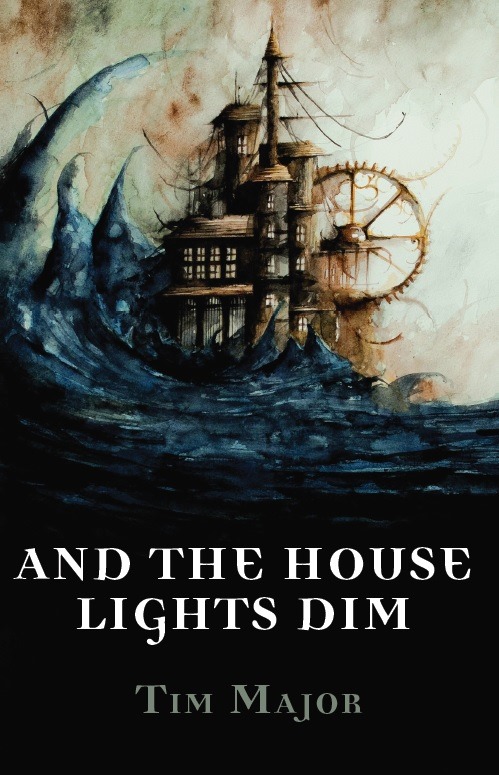
Tim Major’s most recent novels are Hope Island and Snakeskins (both published by Titan Books). His other books include a collection of short stories, And the House Lights Dim, and a non-fiction book about the silent crime film, Les Vampires. His stories have appeared in Interzone, Best of British Science Fiction, Best British Fantasy and Best Horror of the Year. 

1. Tell us three things about yourself.

#1 Despite being a writer and editor of fiction, I have a Maths subject background. I did a Maths degree at university, then got into publishing via educational materials, working first on Maths textbooks. No regrets, but in retrospect I would have far more enjoyed an English degree, and I’m ashamed of the gaps in my knowledge of classic literature.

#2 What’s worse is that I ought to have known better, even back then. My hobbies have always involved writing. When I was a kid I’d borrow my mum’s electronic typewriter and transcribe my favourite Just William stories. I created Doctor Who fanzines with my best friend and then, when he lost interest, entirely on my own, and sold them for a good profit. I’ve been the editor of two small-press magazines (The Quiet Feather, The Singularity) and, more recently, co-editor of the British Fantasy Society’s fiction journal. The idea of me wanting to spend my life doing anything other than working with words is absurd.

#3 Related to #2, I was the biggest Doctor Who fan when I was growing up. My first short story was a fan-fiction sequel to the Cyberman story ‘Silver Nemesis’. With a group of school friends, I built a Dalek out of aluminium cans, which reached the final of a national competition. We were invited to take it to Westminster Bridge to re-enact the famous scene from The Dalek Invasion of Earth, and our Dalek (but not us) was featured on Blue Peter, alongside my hand-drawn schematics. But we didn’t get Blue Peter badges – I’m still sore about that.

2. Many writers have said the COVID-19 outbreak and the lockdown have made it harder for them to create. Have you found this? Has the outbreak affected you as a writer and if so, how?

For the first three weeks, I couldn’t write anything at all. Part of that was practical – my wife and I have two sons, aged 3 and 6, and of course we’re now home-schooling them, and even without that responsibility, their 24-hour presence in the house can be dizzying and tiring (but just as often great fun, obviously). But the other side of it was that writing felt trivial at first, compared to what’s going on right now. After three weeks, a mental switch flipped, and writing seemed vital again – that is, regardless of the state of the world, it’s vital to keep my mind active. Plus, I’ve made being a writer such a fundamental part of my identity that without it, I don’t know who I am.

It’s not easy finding time, though, given that around 7 hours of each day is dedicated to my kids (5 hours of home-schooling/entertaining, 2 hours of either morning or bedtime routine). But my wife and I are lucky in that we’re both freelance editors, and we’ve had setups similar to this one before. We’re pretty adept at finding free time, and allowing each other space when possible, and once we’ve met our deadlines, we’re good at claiming the remaining time to follow our interests. Recently, I’ve been getting around five hours a week of writing time, which is enough to keep the progress going on a novel I’m planning.

I’m reading a lot more than usual though, which is unexpected, and is all good fodder for writing. And I’m filling some of the classic-literature gaps that I mentioned earlier!

3. What was the first thing you had published?

I’m guessing my self-published Doctor Who fan fiction at age 10 doesn’t count… My first short story was accepted for publication in 2013 by a horror magazine called Sanitarium. They even made it the cover story – I was thrilled. My first book was a novella, Carus & Mitch, in 2015. That was my big ambition: to have a book on my shelf with my name on the cover. As it turns out, that delight doesn’t wear off.

4. Which piece of writing are you proudest of?

This may seem a neat coincidence, but I’m very proud of my new novel, Hope Island, which just happens to be published right about now (it’s already out in the US, and 8th June in the UK). It was also the easiest time I’ve had writing a novel. Here’s hoping that correlation will continue…

5. …and which makes you cringe?

Nothing that’s been published, I don’t think. But when I started writing, I decided to write at least two ‘trunk’ novels for practice, before attempting to inflict any of my work on the world. The first two were YA novels, and, as expected, they were awful, but I learned a huge amount that I wouldn’t have been able to learn theoretically. Also, the first few chapters of the second novel became the basis of Carus & Mitch, which acted as my calling card in the UK genre writing scene, and did me a lot of favours.

6. What’s a normal writing day like?

Let’s imagine we’re not in the midst of lockdown… I’ve always been a slow and steady writer, managing a little on most days, which all adds up. Usually, I’d take the kids to school, then write for a couple of hours before burning out sometime before lunch – at which point switching to my day job of editing (usually fiction, but sometimes educational materials) feels far more a pleasure than a chore. I genuinely like editing, whether it’s my own work or other people’s – it’s my flow state.

7. What work of yours would you recommend for people on lockdown and in need of a good book?

I’m trying to avoid the temptation for self-publicity, but I can’t quite resist it… As I say, Hope Island is out on 8th June. It’s about a British mother and her daughter trying to reconnect on a visit to a remote island off the coast of Maine. They encounter creepy children, a strange artistic community, an archaeological dig… and then there are a bunch of murders and it all gets weird. Like I say, I’m really proud of it.

8. What are you working on now?

I’ve just finished up a Victorian fantasy, and now I’m planning a novel that is undoubtedly an expression of my mania during lockdown. Three parallel strands, three different genres, a cast of at least 50… Despite being so busy with the kids and despite the constant anxiety of the real world, I needed a hobby project to occupy me totally in my brief time alone, and this is it. It might end up taking me a while to write, though.


Friday, 7 August 2015

The Lowdown with... Tim Major

Today's Lowdown focuses on GAME OVER contributor Tim Major, who lives in Oxford with his wife and son. His love of speculative fiction is the product of a childhood diet of classic Doctor Who episodes and an early encounter with Triffids. Tim’s horror novella, Carus & Mitch, was published
by Omnium Gatherum in February 2015. His short stories have featured in publications such as Interzone, Perihelion, Every Day Fiction and the Infinite Science Fiction anthology. He blogs about writing and reading here and you can follow him on Twitter here.


1. Tell us three things about yourself.

Between the ages of eight and fourteen, Doctor Who was pretty much the most important thing in the world to me. I jumped on board just in time to see the classic show come to an end, but fandom, Target novelisations and the Virgin New Adventures series kept me going. I still think of Doctor Who more as a book series than a TV show. Doctor Who, along with John Wyndham novels, made me who I am.

Most of my stories feature a horror element, but I’ve never been much of a horror reader myself. I find suspense more satisfyingly upsetting than gore. Shirley Jackson is wonderful, but the unrelenting tension in Patricia Highsmith novels scratches the same itch. I fear socially awkward situations, which is why I’d class the recent film, ‘Force Majeure’, as a horror. It’s excruciating.

I live by lists. I list and rate films, books and albums. I work through ‘best of’ charts methodically. Most importantly, my writing progress and story submissions are contained in detailed spreadsheets. Even when I’m not in the mood to write, the satisfaction of charting progress is often enough to give myself a push. Without the lists, I’d flounder immediately.

2. What was the first thing you had published?

When I was about ten I wrote a sequel to the Doctor Who story, ‘Silver Nemesis’, featuring Cybermen in Ancient Egypt. I typed it up, got my dad to photocopy a few dozen copies and illustrated the front cover myself. Then I sold it to friends, family and teachers. I made a fair profit because the cover price was, quite frankly, outrageous.

My first proper fiction sale was a story called ‘The House Lights Dim’ to Sanitarium magazine, back in 2013. That’s not so long ago, really. Thing have been chugging along steadily since then.

3. Which piece of writing are you proudest of?

I’ve written a novel called ‘The House-sitter’, about a man who steals a time machine, then hides in a remote Cumbrian mansion to test it. Naturally, things go awry. It’s slow-burn and creepy, and I think it’s pretty good. Even so, it’s still sitting in my desk drawer.

4. …and which makes you cringe?

Back in 2011 I completed my first impromptu NaNoWriMo-style challenge (in February rather November, due to my impatience to get started). I wrote like a demon for a month. The resulting YA novel was abysmal, but I had no qualms in chucking it away. Behaving like a writer for a whole month let me develop ways of continuing to write regularly. I haven’t stopped since. Come to think of it, that first novel did have one saving grace: the title was excellent. I’m planning to reuse it for my next project.

5. What’s a normal writing day like?

I don’t have writing days. My son is nearly two; any time when I’m not at my day job and he’s awake, then he calls the shots. I write in dribs and drabs – before work, during lunch breaks and in the evenings – wherever I can set down my laptop and get going. The only important elements are headphones and Spotify. I listen to drone and minimalist music constantly when I write. It’s less like a trance state and more a way of pretending that I’m an efficient, clunking, clanking writing machine, which I certainly am not.
 
6. Which piece of writing should someone who’s never read you before pick up first?

Probably my novella, ‘Carus & Mitch’, which was published by Omnium Gatherum in February 2015. It’s about two young girls who live in isolation, boarded up within their house. During the story Mitch challenges Carus to piece together the reasons why they’re sheltering there, and what may really be outside. It covers all my main bases: it’s resolutely British, it features a mystery, and it’s not nearly as overtly science-fictional as it might at first seem. Readers and reviewers have been very nice about it.

7. What are you working on now? 

I’m just finishing up with a medieval time-travel adventure novel. At least, it started as an adventure. Over the course of four drafts it’s become darker and bleaker. I guess there’s something about multiple rewrites that gets me all gloomy.


Tim on Amazon UK and Amazon.com